So, if RISD were to design and construct a student center. What are the five indespensible elements that would be necessarry for it's survival and viability?
I should start with this: Over the passed couple of weeks I have finally been able to begin to answer the question, 'What do I want from my education that I am not getting?'. Or to put if more pointedly, 'When considering the obsence amount I am paying for tuition, where is RISD falling short?'.
Some of my grievances are: That I can't go to a school run dining area for anything resembling a nutritious, fresh, grown-up meal, nor can I eat it somewhere that doesn't smell like a junior-high school cafeteria. I'm a grown-ass individual that pays a whole bunch of money to be here, don't I deserve fine dining experiences?
That I am trapped at a desk the size of a bathroom sink, elbow to elbow with others trapped at desks the size of a bathroom sink, and expected to produce inspired, well-crafted projects.
That I have to pay exorbitant prices for prints in studio.
That I am not getting the forward thinking, cutting-edge education that was promised by the RISD website and brochure.
The ability to move freely (in an academic sense) and design the curriculum that best serves my educational desires.
So, with these points in mind (and sometimes not) a successful student center should be equipped with the five following elements:
1. A dining area not resembling in appearance or odor a junior high cafeteria that serves grown-up food. That they serve alcohol would be an added bonus.
2. Student services offices: academic advising (for our self-designed curriculum), OPE, OSL, GSA, UGSA.
3. Music venue (with a bar).
4. A proper bookstore.
5. Both indoor and outdoor spaces for gathering and interacting.
In closing, we all know a campus bar would be killer, but I'm not sure the student center is the place for it.
Showing posts with label BG. Show all posts
Showing posts with label BG. Show all posts
Monday, May 11, 2009

Monday, March 30, 2009
Kite Day

Kite Day is a day-long event celebrating Springtime and Community, and advocating urban open space. It takes place during a selected day in April, National Kite Month. At the selected site, all will be invited to fly their own kite. A number of white kites will be distributed during the weeks preceding the event, and there will be a number on hand the day of the event. Kites will also be used a advertisement with all event info and instructions printed directly on them. These kites will also have an area on which the participant will be asked to fill in the blank ‘OPEN SPACE IS ‘. The kites will be white. The messages will be black. They will be individual, but of the same language. By delivering kites and instructions to them directly, local educational institutions such as New Urban Arts ,Hope High School, and Vartan Gregorian Elementary will be invited to participate directly.
The program of the event will be kept intentionally diverse, there will be areas to decorate the kites, refreshments, and possibly a band. The aim of the event to create a moment of pause where members of the community may come together with a common interest. The act of kite-flying elicits many nostalgic memories for us, it carries with it connotations of Springtime and rebirth. It is light and playful, yet the visual poetry of the sight of tens (or hundreds) of kites being flown in unison amongst the thrust of high rise buildings may serve to remind us of the preciousness of urban open space. It would be magical to see kites being flown in on a site where it will never again be possible, as the site will be inevitably be occupied by another building or parking structure. This project creates a direct connection between earth and sky and our inextricable connection to both as humans.
At the end of the of the event, the kites will be collected, organized, and with a written manifesto submitted to city hall as a document to the ongoing need for urban open space.
Monday, March 16, 2009
An Interview with Chris Andries

Interview With Chris Andries
Monday, March 9 2009
Chris Andries is the current co-owner and operator of Armageddon Shop, a record store & mail order store located in Providence, RI. Armageddon Shop opened in 2001, and is an hub of community activity.
Chris has also been the primary booking manager at AS220.
Over the course of our conversation, I asked Chris about his involvement in the Providence community, as an owner of a record store. We spoke specifically about his role in the Providence rock community as the booking manager at AS220. Chris spoke explicitly to the importance of effective physical advertising, methods of mobilization, and the importance of cross-programmatic spaces.
At Armageddon, Chris supports local artists. He allows local musicians to shamelessly plaster the front windows of the shop with concert bills, of which he keeps on and therefore has amassed quite a rare archive of Providence musical ephemera. Inside the shop he encourages local artists to hang artwork, display magazines, shirts, and of course cd’s, all on consignment. On a more personal note, Christ has bore witness to casual interactions at Armageddon blossom into, not only relationships of a musical nature, but of a romantic one.
To be continued….


Monday, March 2, 2009
Thoughts on Bourriaud and Relational Aesthetics
Modern (private) v. contempory (public)
Contemporary art should open a dialogue that never ends
Collective elaboration of meaning : being-together
Relational arts allow for the possibility of an immediate discussion, as opposed to post-script art forms like cinema, theater, written word, or privately consumed entertainment (tv, computer).
Interstice: trading communities that escaped the framework of the capitalist economy
‘zones of communication’ are forced on us – parallel to Jacobs.
Also in line with Jacobs, ‘the general mechanization of social functions is gradually reducing our relational space’.
An idea: ‘ambiguous space’
An exhibition is a privileged place where ‘instant communities like this can be established depending on the degree of audience participation demanded by the artist.’
Art is a state of encounter (commerce).
‘It is illusory to count on the gradual transformation of society on anything other than ‘microscopic’ levels’
-Feilix Guattari
Art of the 80s emphasized the visual aspect while the relationists emphasize contact and tactility.
Relational art is born of the observation of the present (itruth, authenticity, reasonable observation?)
Relational art gives ‘everyone a chance thanks to forms that do not give the producer any a priori superiority. The viewer becomes passive consumer, witness, assiociate, client, guest, co-producer, antagonist/protagonist.’
Contemporary art should open a dialogue that never ends
Collective elaboration of meaning : being-together
Relational arts allow for the possibility of an immediate discussion, as opposed to post-script art forms like cinema, theater, written word, or privately consumed entertainment (tv, computer).
Interstice: trading communities that escaped the framework of the capitalist economy
‘zones of communication’ are forced on us – parallel to Jacobs.
Also in line with Jacobs, ‘the general mechanization of social functions is gradually reducing our relational space’.
An idea: ‘ambiguous space’
An exhibition is a privileged place where ‘instant communities like this can be established depending on the degree of audience participation demanded by the artist.’
Art is a state of encounter (commerce).
‘It is illusory to count on the gradual transformation of society on anything other than ‘microscopic’ levels’
-Feilix Guattari
Art of the 80s emphasized the visual aspect while the relationists emphasize contact and tactility.
Relational art is born of the observation of the present (itruth, authenticity, reasonable observation?)
Relational art gives ‘everyone a chance thanks to forms that do not give the producer any a priori superiority. The viewer becomes passive consumer, witness, assiociate, client, guest, co-producer, antagonist/protagonist.’
Sunday, March 1, 2009
People, Places, Things

Alisha
Senior in Painting
Q. What is Community?
A. A group with like interests and obligations.
Q. Is this definition of community present at RISD?
A. Not across departmental lines.
Q. What is a space significant to your community?
A. Senior painting studios in the College Building.
Q. Are you interested in belonging to a greater RISD community?
A. Yes
Q. In what ways could a greater sense of community be developed?
A. There could be more community building activities: meetings with a clear, common goal and a productive output.
.jpg)
.jpg)
.jpg)
.jpg)
**************************************************
+copy.jpg)
Thomas
Junior in Architecture
Q. What is Community?
A. A collective, which can give one a strong base to touch upon.
Q. Is this definition of community present at RISD?
A. No, due to a tendency for students here to be quite self-centered. We run around with 'blinkers'.
Q. What is a space significant to your community?
A. Second floor architecture studios in the BEB. Community is found primarily in the studio environment where everybody is reliant on one-another.
Q. Are you interested in belonging to a greater RISD community?
A. Yes.
Q. In what ways could a greater sense of community be developed?
A. Unsure. An attempt was made at creating a 'common space' at the RISD store, but unfortunately that enterprise has fallen short.
.jpg)
.jpg)
.jpg)
**************************************************
.jpg)
Joo-Dung
Junior in Industrial Design
Q. What is Community?
A. A gathering of people with a common goal or interest.
Q. Is this definition of community present at RISD?
A. At RISD, community is fragmented by departmental lines. No common goals unite each department.
Q. What is a space significant to your community?
A. Junior studios in the Industrial Design Building. Studio is the center of his existence. Also, he spends some time on the lounge couch on his floor. He and his studio mates have a ritual of making the trip from the I.D. building to the downtown 7/11 during all-nighters.
Q. Are you interested in belonging to a greater RISD community?
A. Yes.
Q. In what ways could a greater sense of community be developed?
A. Not being able to participate in community is not necessarily a spacial issue, it can often be due to a simple lack of time. Spacially, the RISD store is an attempt at creating a communal space, but somehow is not conducive to that. It is a social object which lacks quality. Most schools have an abundance of sports activities, and other non-academic related public gatherings. At RISD, we seem to have a need to organize public gatherings which center around our academic output, art and design, which we see constanltly anyway.
.jpg)
.jpg)
.jpg)
.jpg)
.jpg)
*****************************************************
.jpg)
Sanna
First year graduate in Architecture
Q. What is Community?
A. A group of people interacting regardless of personal interest and with a general sense of care or regard.
Q. Is this definition of community present at RISD?
A. No.
Q. What is a space significant to your community?
A. Third floor architecture studio in the B.E.B. Community at RISD is confined to the studio environment.
Q. Are you interested in belonging to a greater RISD community?
A. Yes. I want to develop community on a broader level.
Q. In what ways could a greater sense of community be developed?
A. We should have more public and gallery events that are better communicated through a more comprehensive infrastructure.
.jpg)
.jpg)
*******************************************************

Tuesday, February 24, 2009
Google Maps: How-To
Adding locations, images, and text to our Google Map.
1. Access our Google map here.
2. Click on the Edit button beneath the map directory.

3. Select the 'pin' icon from the button options.

4. Drag the pin to desired location and click to pin it to the map.

5. You may now add a title for your location, and descriptive text. Click on the rich text option to to upload images from your computer, or from a URL.

Voila!
1. Access our Google map here.
2. Click on the Edit button beneath the map directory.

3. Select the 'pin' icon from the button options.

4. Drag the pin to desired location and click to pin it to the map.

5. You may now add a title for your location, and descriptive text. Click on the rich text option to to upload images from your computer, or from a URL.

Voila!
Sunday, February 22, 2009
Much or Nothing
Here at RISD we are all citizens of an archipelago of departments and buildings, each one being quite private and unrelated. Though some attempts are made at community building within our institution, we are often left feeling uninformed and un-united.
In her anthropological survey of American cities, The Death and Life of Great American Cities, Jane Jacobs makes many observations that may begin to elucidate the obstacles an institution such as RISD faces when attempts at community building are waged.
In her chapter of the importance of the city sidewalk, Jane Jacobs illustrates her point by comparing an old-city sidewalk with the public spaces of a planned community project.
”The houses here are grouped in colonies around shared interior lawns and play yards, and the whole development is equipped with other devices for close sharing, such as a residents’ club which holds parties, dances, reunions, has ladies’ activities like bridge and sewing parties, and holds dances and parties for the children. There is no public life here, in any city sense. There are differing degrees of extended private life.”1 In many ways, these sentences describe the functionality of the RISD community.
At RISD we certainly are not in lack of common shared spaces, but none of them cultivate the kind of everyday, casual encounters that Jacobs sites as being so indispensible in the cultivation of community trust. I can think of only a one or two RISD affiliated establishments that are poised to facilitate these kinds of interactions, one being the student-run Carr Haus. RISD social life is based primarily around formal events and behavior-specific locations. As Jacobs argues, these trust-building encounters cannot be institutionalized nor formalized. RISD, therefore, stands at a disadvantage in it’s current condition.
The greater RISD community also suffers from another problem, that of departmental insularity. Another Jacobs passage alludes to this as it may relate to RISD: “These projects are not lacking in natural leaders,” she says. “They contain people with real ability, wonderful people many of them, but the typical sequence is that in the course of the organization leaders have found each other, gotten all involved in each other’s social lives, and have ended up talking to nobody but each other. They have not found their followers. Everything tends to degenerate into ineffective cliques, as a natural course. There is no normal public life. Just the mechanics of people learning what I going on is so difficult. It all makes the simples social gain extra hard for these people.” 2
The points Jacobs makes, are certainly valid points of departure when exploring ways to develop community within RISD, and without. Perhaps what are needed are more non-RISD locations where casual social interactions can occur.
My question is this, “what exactly is the relevance of Jacobs’ claims today, over fifty years after they were conceived”. What are the implications of her claims in light of the added social barriers we have imposed on ourselves, i.e. online social networking?
1. Jacobs, Jane, The Death and Life of Great American Cities, Modern Library, 1951, p 83.
2. Ibid, p 89.
Here at RISD we are all citizens of an archipelago of departments and buildings, each one being quite private and unrelated. Though some attempts are made at community building within our institution, we are often left feeling uninformed and un-united.
In her anthropological survey of American cities, The Death and Life of Great American Cities, Jane Jacobs makes many observations that may begin to elucidate the obstacles an institution such as RISD faces when attempts at community building are waged.
In her chapter of the importance of the city sidewalk, Jane Jacobs illustrates her point by comparing an old-city sidewalk with the public spaces of a planned community project.
”The houses here are grouped in colonies around shared interior lawns and play yards, and the whole development is equipped with other devices for close sharing, such as a residents’ club which holds parties, dances, reunions, has ladies’ activities like bridge and sewing parties, and holds dances and parties for the children. There is no public life here, in any city sense. There are differing degrees of extended private life.”1 In many ways, these sentences describe the functionality of the RISD community.
At RISD we certainly are not in lack of common shared spaces, but none of them cultivate the kind of everyday, casual encounters that Jacobs sites as being so indispensible in the cultivation of community trust. I can think of only a one or two RISD affiliated establishments that are poised to facilitate these kinds of interactions, one being the student-run Carr Haus. RISD social life is based primarily around formal events and behavior-specific locations. As Jacobs argues, these trust-building encounters cannot be institutionalized nor formalized. RISD, therefore, stands at a disadvantage in it’s current condition.
The greater RISD community also suffers from another problem, that of departmental insularity. Another Jacobs passage alludes to this as it may relate to RISD: “These projects are not lacking in natural leaders,” she says. “They contain people with real ability, wonderful people many of them, but the typical sequence is that in the course of the organization leaders have found each other, gotten all involved in each other’s social lives, and have ended up talking to nobody but each other. They have not found their followers. Everything tends to degenerate into ineffective cliques, as a natural course. There is no normal public life. Just the mechanics of people learning what I going on is so difficult. It all makes the simples social gain extra hard for these people.” 2
The points Jacobs makes, are certainly valid points of departure when exploring ways to develop community within RISD, and without. Perhaps what are needed are more non-RISD locations where casual social interactions can occur.
My question is this, “what exactly is the relevance of Jacobs’ claims today, over fifty years after they were conceived”. What are the implications of her claims in light of the added social barriers we have imposed on ourselves, i.e. online social networking?
1. Jacobs, Jane, The Death and Life of Great American Cities, Modern Library, 1951, p 83.
2. Ibid, p 89.
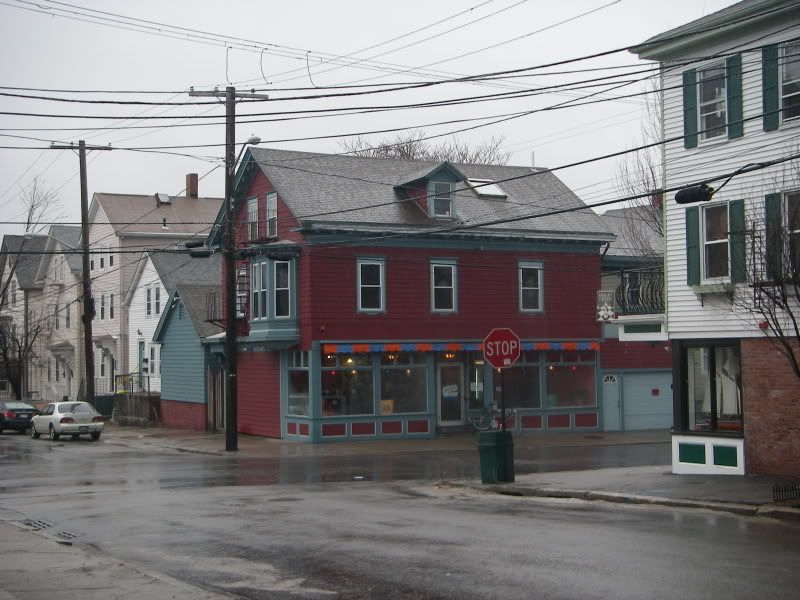
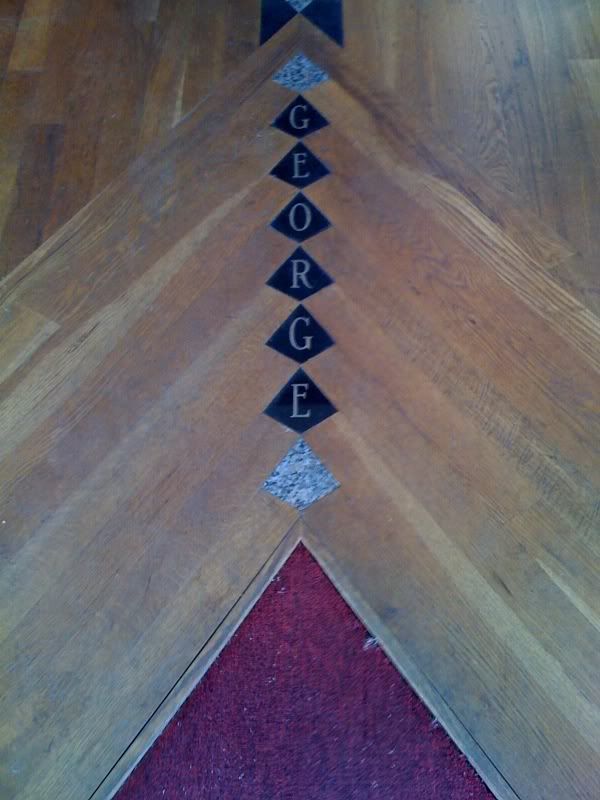
George's
George's
Established Autumn 2007
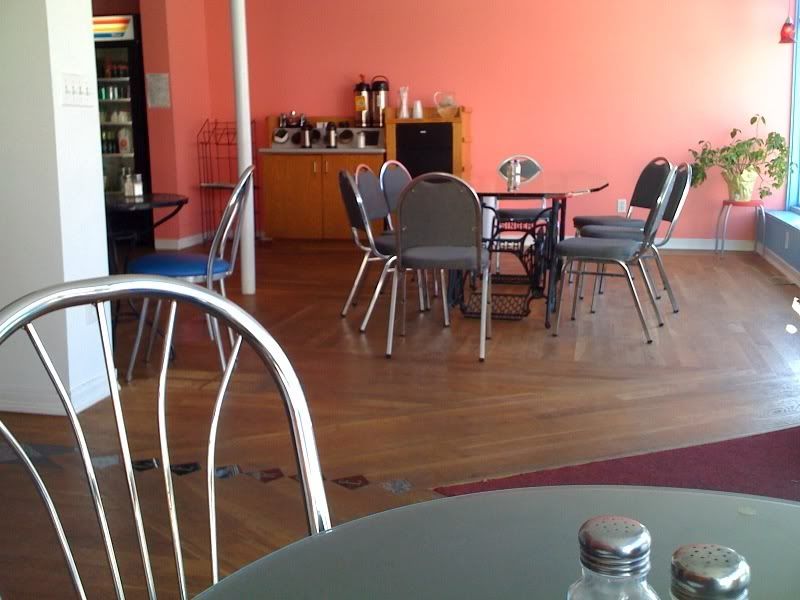
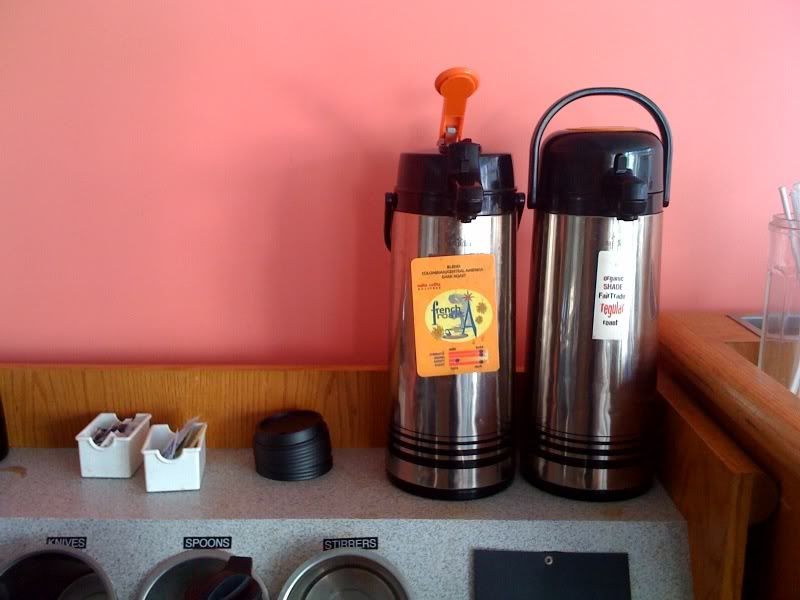
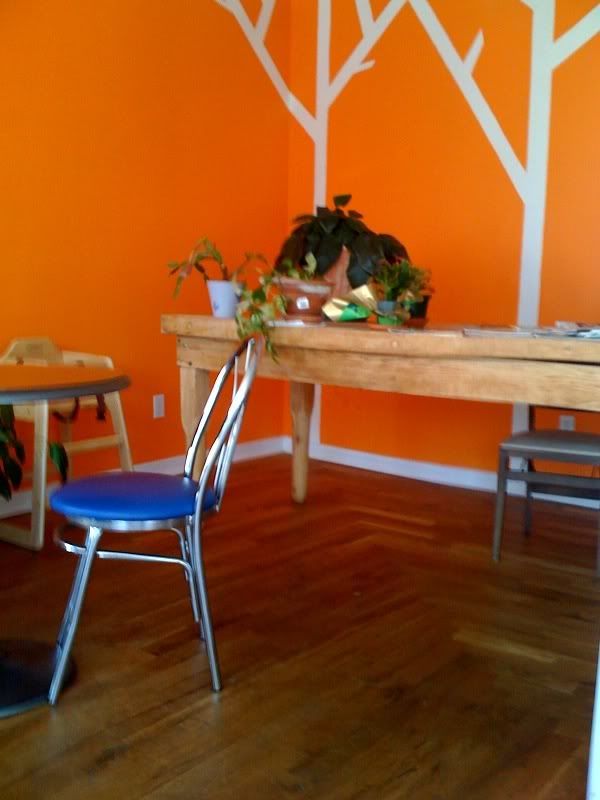
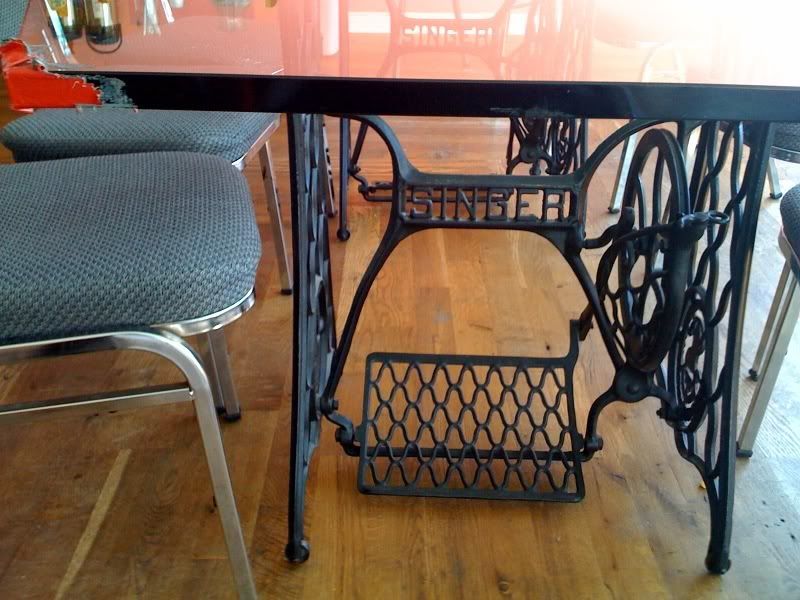
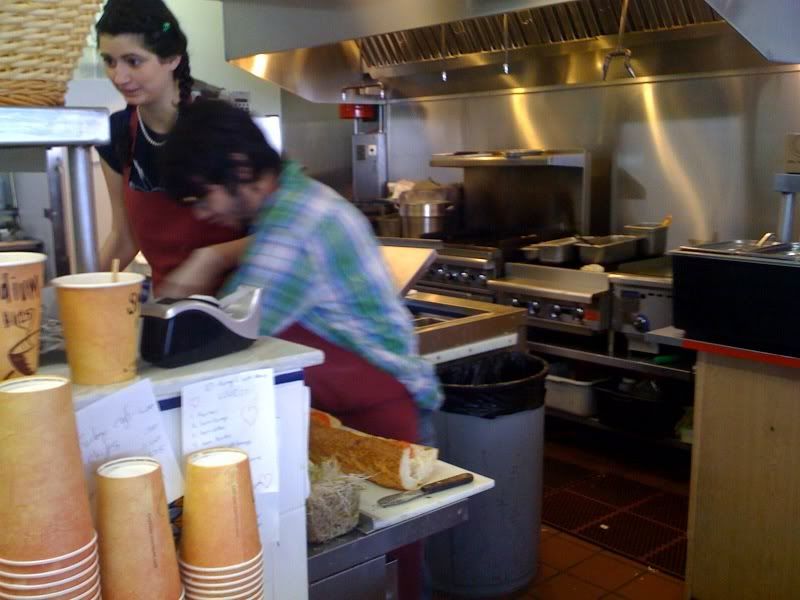
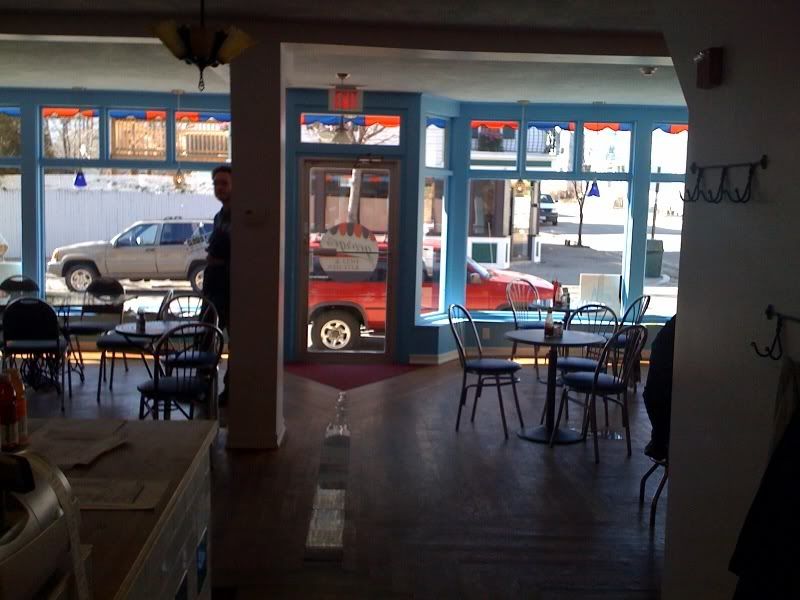
One of several new businesses in the rapidly growing Fox Point neighborhood centered around Ives street. Not only serving delicious and reasonably priced food*, George's acts as a meeting place for the exchange of ideas and information.
During wintersession 2009, a group of friends and I created a Friday morning breakfast club. Most of us are graduate students living in and about the Fox Point area, and George's was a natural choice as a meeting place. Though these meetings began as casual exchanges amongst a group of like-minded friends, over the next six weeks they developed into something more. As our conversations grew, my friends and I discussed our emotional states, personal histories and projects and ideas that had been consuming our imaginations. Many nourishing collaborations were borne of these conversations.
Additionally, as our friendships and creative endeavors developed, we were (however subconsciously) creating a repoire with a cast of neighborhood characters and entering a meaningful communal exchange.
At the time of these meetings it was unclear why George's was so vital for my neighborhood and social circle. After considering Jane Jacob's chaper "Use of Side Sidewalks: Contact" the importance of such an establishment in a small neighborhood may be more apparent. Fox Point is composed largely of private residences. Casual street interaction is limited. There is a lack of community space where everyday interactions may take place. In a way George's provides a venue for casual exchanges between individuals. I am now on a first-name basis with each of employees at George's. Furthermore, I have grown to recognize many characters from the neighborhood whom also frequent George's, none of whom I have considered pursuing a more personal relationship with. Though my conversations with these people may seem trivial on the surface, they are vital for developing the casual trust between individuals which is so important a foundation for developing a true sense of community.
George's has thus become the venue, or medium, through which a group of friends has grown with each other, and has begun to know and appreciate their neighbors and community.


*One Egg, Sausage, Home Fries and Toast: $3.75

Established Autumn 2007
One of several new businesses in the rapidly growing Fox Point neighborhood centered around Ives street. Not only serving delicious and reasonably priced food*, George's acts as a meeting place for the exchange of ideas and information.
During wintersession 2009, a group of friends and I created a Friday morning breakfast club. Most of us are graduate students living in and about the Fox Point area, and George's was a natural choice as a meeting place. Though these meetings began as casual exchanges amongst a group of like-minded friends, over the next six weeks they developed into something more. As our conversations grew, my friends and I discussed our emotional states, personal histories and projects and ideas that had been consuming our imaginations. Many nourishing collaborations were borne of these conversations.
Additionally, as our friendships and creative endeavors developed, we were (however subconsciously) creating a repoire with a cast of neighborhood characters and entering a meaningful communal exchange.
At the time of these meetings it was unclear why George's was so vital for my neighborhood and social circle. After considering Jane Jacob's chaper "Use of Side Sidewalks: Contact" the importance of such an establishment in a small neighborhood may be more apparent. Fox Point is composed largely of private residences. Casual street interaction is limited. There is a lack of community space where everyday interactions may take place. In a way George's provides a venue for casual exchanges between individuals. I am now on a first-name basis with each of employees at George's. Furthermore, I have grown to recognize many characters from the neighborhood whom also frequent George's, none of whom I have considered pursuing a more personal relationship with. Though my conversations with these people may seem trivial on the surface, they are vital for developing the casual trust between individuals which is so important a foundation for developing a true sense of community.
George's has thus become the venue, or medium, through which a group of friends has grown with each other, and has begun to know and appreciate their neighbors and community.
*One Egg, Sausage, Home Fries and Toast: $3.75

Subscribe to:
Posts (Atom)